
Welcome to Bodhiclasses – your digital classroom companion that transforms school textbooks into powerful learning experiences. In this post, we bring you fully solved questions from Chapter 10 Life Processes in Plants of the NCERT Class 7 Science book. Use this for revision, homework help, or test preparation!

Q1. Complete the following table:
| S.No. | Feature | Photosynthesis | Respiration |
|---|---|---|---|
| 1 | Raw materials | Carbon dioxide, Water | Glucose, Oxygen |
| 2 | Products | Glucose (Starch), Oxygen | Carbon dioxide, Water, Energy |
| 3 | Word equation | CO₂ + H₂O → (Sunlight + Chlorophyll) → C₆H₁₂O₆ + O₂ | C₆H₁₂O₆ + O₂ → CO₂ + H₂O + Energy |
| 4 | Importance | Produces food and oxygen | Releases energy for growth and activities |
Q2. Imagine a situation where all the organisms that carry out photosynthesis on the earth have disappeared. What would be the impact of this on living organisms?
Answer:
If photosynthetic organisms disappeared, there would be a major ecological crisis. No oxygen would be produced, leading to suffocation of all aerobic organisms. Additionally, no new food would be generated, causing the collapse of food chains and the extinction of most life forms.
Q3. A potato slice shows the presence of starch with iodine solution. Where does the starch in potatoes come from? Where is the food synthesised in the plant, and how does it reach the potato?
Answer:
Starch in potatoes comes from glucose made during photosynthesis in the leaves. Leaves synthesize food, which is then transported through phloem tissues to the potato, where it is stored as starch.
Q4. Does the broad and flat structure of leaves make plants more efficient for photosynthesis? Justify your answer.
Answer:
Yes, the broad and flat surface of leaves increases the surface area for absorbing sunlight and gas exchange, making photosynthesis more efficient.
Chapter 10 Life Processes in Plants
Q5. X is broken down using Y to release carbon dioxide, Z, and energy.
X + Y → Carbon dioxide + Z + Energy
X, Y, and Z are three different components of the process. What do X, Y, and Z stand for?
Answer:
- X = Glucose
- Y = Oxygen
- Z = Water
Q6. Krishna set up an experiment with two potted plants of same size and placed one of them in sunlight and the other in a dark room (Fig. 10.10).
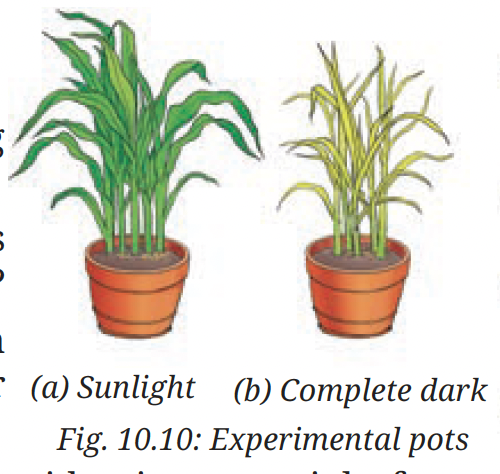
(i) What idea might she be testing through this experiment?
Answer: To test the effect of sunlight on photosynthesis and starch formation in plants.
(ii) What are the visible differences in plants in both the conditions?
Answer: The plant in sunlight appears green, healthy, and grows well. The plant in darkness looks pale, weak, and shows little or no growth.
(iii) According to you, leaves of which plants confirm the iodine test for the presence of starch?
Answer: Leaves of the plant kept in sunlight will confirm the iodine test for starch presence.
Chapter 10 Life Processes in Plants
Q7. Vani believes that ‘carbon dioxide is essential for photosynthesis’. She sets up an experiment with plants under the following conditions (Fig. 10.11):
(a) Sunlight with carbon dioxide
(b) Sunlight without carbon dioxide
(c) Dark with carbon dioxide
(d) Dark without carbon dioxide
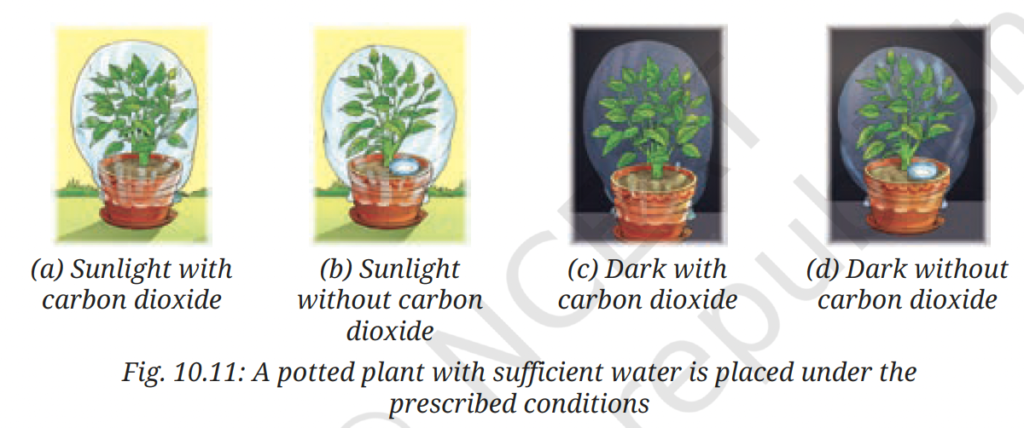
(i) In which plant(s) in the above set-up(s) will starch be formed?
Answer: Only in (a) – Sunlight with carbon dioxide.
(ii) In which plant(s) in the above set-up(s) will starch not be formed?
Answer: (b), (c), and (d) – because one or more essential factors for photosynthesis are missing.
(iii) In which plant(s) in the above set-up(s) will oxygen be generated?
Answer: Only in (a) – Sunlight with carbon dioxide.
(iv) In which plant(s) in the above set-up(s) will oxygen not be generated?
Answer: (b), (c), and (d).
Q8. Ananya took four test tubes and filled them as follows (Fig. 10.12):
A: Snail only
B: Water plant only
C: Snail + water plant
D: Only water
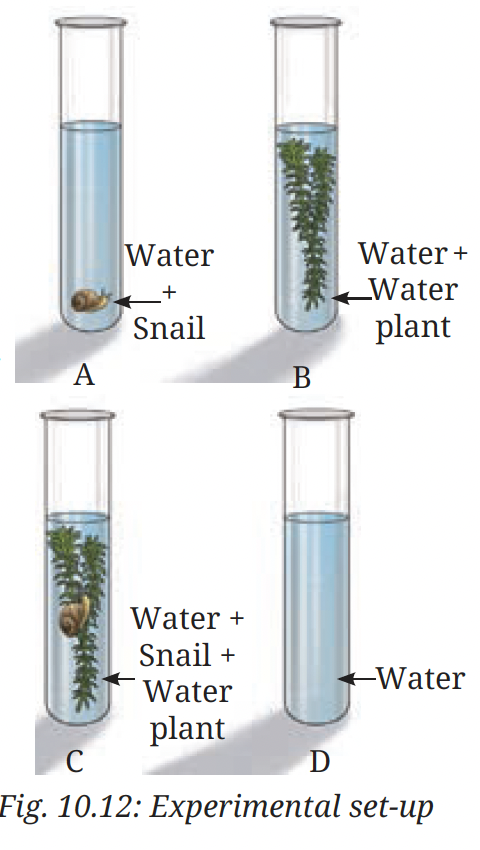
She used a carbon dioxide indicator.
What do you think she wants to find out? How will she know if she is correct?
Answer:
Ananya wants to test carbon dioxide production and consumption through respiration and photosynthesis. She will observe colour changes in the carbon dioxide indicator:
- A (Snail only): Indicator will turn milky – respiration releases CO₂.
- B (Plant only): Indicator may stay clear or become less milky – photosynthesis uses CO₂.
- C (Snail + Plant): Balanced CO₂ due to both processes – slight or no colour change.
- D (Water only): No change – control group.
Chapter 10 Life Processes in Plants
Q9. Design an experiment to observe if water transportation in plants is quicker in warm or cold conditions.
Answer:
- Take two similar white flower plants.
- Place each in a beaker with red-coloured water.
- Keep one plant in a warm place and the other in a cool place.
- Observe how quickly the red colour rises up the stem and appears in petals.
Conclusion: The plant in the warm environment will transport water faster due to increased transpiration rate.
Q10. Photosynthesis and respiration are essential to maintain balance in nature. Discuss.
Answer:
Photosynthesis absorbs carbon dioxide and releases oxygen. Respiration uses oxygen and releases carbon dioxide. These two processes maintain the oxygen–carbon dioxide balance in the atmosphere, support food production, and enable energy flow in ecosystems.
Chapter 10 Life Processes in Plants
